
Assessment Methodology and Quality Standards
Legal Spine approaches every medicolegal instruction with a disciplined methodology designed to produce reports that are clinically rigorous, procedurally defensible and immediately useful to courts, tribunals and statutory decision-makers.
The assessment process is not a single consultation, but a series of structured stages that begin with document review and end with a carefully edited, court-ready opinion.
This multi-layered workflow reflects both neurosurgical best practice and the expectations of schemes such as TAC, WorkSafe, Comcare and Wrongs Act authorities, which require complete and thorough impairment and medical assessments anchored in AMA-based methodologies and applicable legislation.
Expert duties and report standards
All assessments at Legal Spine are conducted within the framework of recognised expert witness duties. The overriding obligation is to assist the court or tribunal impartially within the field of neurosurgery, not to advocate for the party who has provided instructions.
Opinions are grounded in clearly identified material, confined to areas of genuine expertise and articulated with transparent reasoning so decision-makers can follow the logic from evidence to conclusion.
- Identify the brief, legal context and all material relied upon.
- Distinguish facts from assumptions and opinion.
- Explain how guidelines and statutory tests have been applied.
- Acknowledge limitations, uncertainties and alternative explanations where they exist.
Scope limits and supplementary opinions
Scope limits are explicit. When questions stray outside neurosurgery, such as purely psychiatric, vocational or actuarial issues, those issues are identified as beyond scope and no speculative opinion is offered.
Where the brief is incomplete or key information is missing, including absent imaging, incomplete medical records or unclear accident chronology, the report states the gaps, explains any necessary assumptions and discusses how those limitations affect the strength or generality of the conclusions.
If significant new information later emerges, such as further surgery, new imaging or additional expert opinions, the practice treats any supplementary report as part of the continuing duty to assist the court and statutory bodies, rather than as an opportunity to defend an earlier view.
A disciplined medicolegal workflow
At its core, a medicolegal assessment is a bridge between clinical medicine and legal decision-making, undertaken not to provide treatment but to deliver an objective opinion for statutory and court processes.
Legal Spine's workflow begins long before a claimant enters the consulting room, with detailed analysis of the brief and supporting documentation to identify the real issues in dispute: causation, permanency, work capacity, reasonableness of treatment or impairment thresholds.
From there, the practice follows a consistent sequence: preliminary document review, targeted history-taking, comprehensive neurological examination, integration of imaging and neurophysiological evidence, guideline-based impairment analysis where relevant, and drafting and internal review of a structured report aligned with scheme templates and court expectations.
Comprehensive pre-assessment review
Before any examination, the practice undertakes a meticulous review of the material provided, including prior medicolegal reports, treating specialist correspondence, operative notes, imaging reports, scheme decisions and, where relevant, surveillance or workplace documentation.
This pre-assessment review mirrors the expectations of formal impairment-assessment training programmes, which emphasise a thorough understanding of legislative frameworks and consistent application of AMA Guides and scheme-specific instruments.
It also ensures that the face-to-face consultation is focused and efficient, with key areas of contention explored in depth rather than discovered belatedly after the claimant has left.
Where the brief is obviously incomplete, such as missing key imaging or operative notes, the practice may request further material before or after the consultation, and the report will record any residual gaps and their potential impact.
- Map the chronology of the injury.
- Identify gaps or inconsistencies in the history.
- Understand the legal context, including TAC no-fault benefits, WorkSafe weekly payments, Wrongs Act significant injury thresholds or Comcare permanent impairment claims.
Structured history-taking beyond a single conversation
The practice does not rely on a single, hurried interview to capture the history of a complex spinal or brain injury. Instead, history-taking is structured as a multi-step process that triangulates information from multiple sources.
This layered approach is particularly important where claimants have cognitive issues, chronic pain, psychological distress or language barriers that may compromise the reliability of a single interview.
- Instruction letters, pleadings and statutory decision documents.
- Medical records and imaging archives.
- Pre-appointment claimant questionnaires.
- The in-person or video-based consultation.
- Extract relevant facts from the brief, including prior injuries, comorbidities, treatments and employment history.
- Check available radiology providers and retrieve scans to match reported events and dates.
- Issue pre-appointment questionnaires, with assistance available for literacy or language difficulties.
- Conduct a detailed interview that reconciles the history and clarifies functional impact on daily activities and work.
Neurological examination and functional assessment
The physical examination is designed to be thorough, respectful and tightly focused on the body regions and functions in dispute. For spinal and neurological claims, this typically includes assessment of gait, posture, spinal range of motion, motor strength, reflexes, sensation, coordination and, where relevant, cranial nerve function.
In line with scheme guidance, the examination goes beyond simple observation, incorporating formal measurements where these are relevant to impairment ratings, such as goniometric assessment of joint ranges of motion or detailed mapping of sensory loss.
Functional enquiry covers not only work demands but also domestic activities, self-care, driving, sleep and recreational pursuits, giving context to the clinical findings and helping distinguish temporary incapacity from permanent impairment.
Care is taken to minimise discomfort, explain each step and preserve dignity, particularly where chronic pain or psychological distress are prominent features of the presentation.
Integration of imaging and neurophysiological investigations
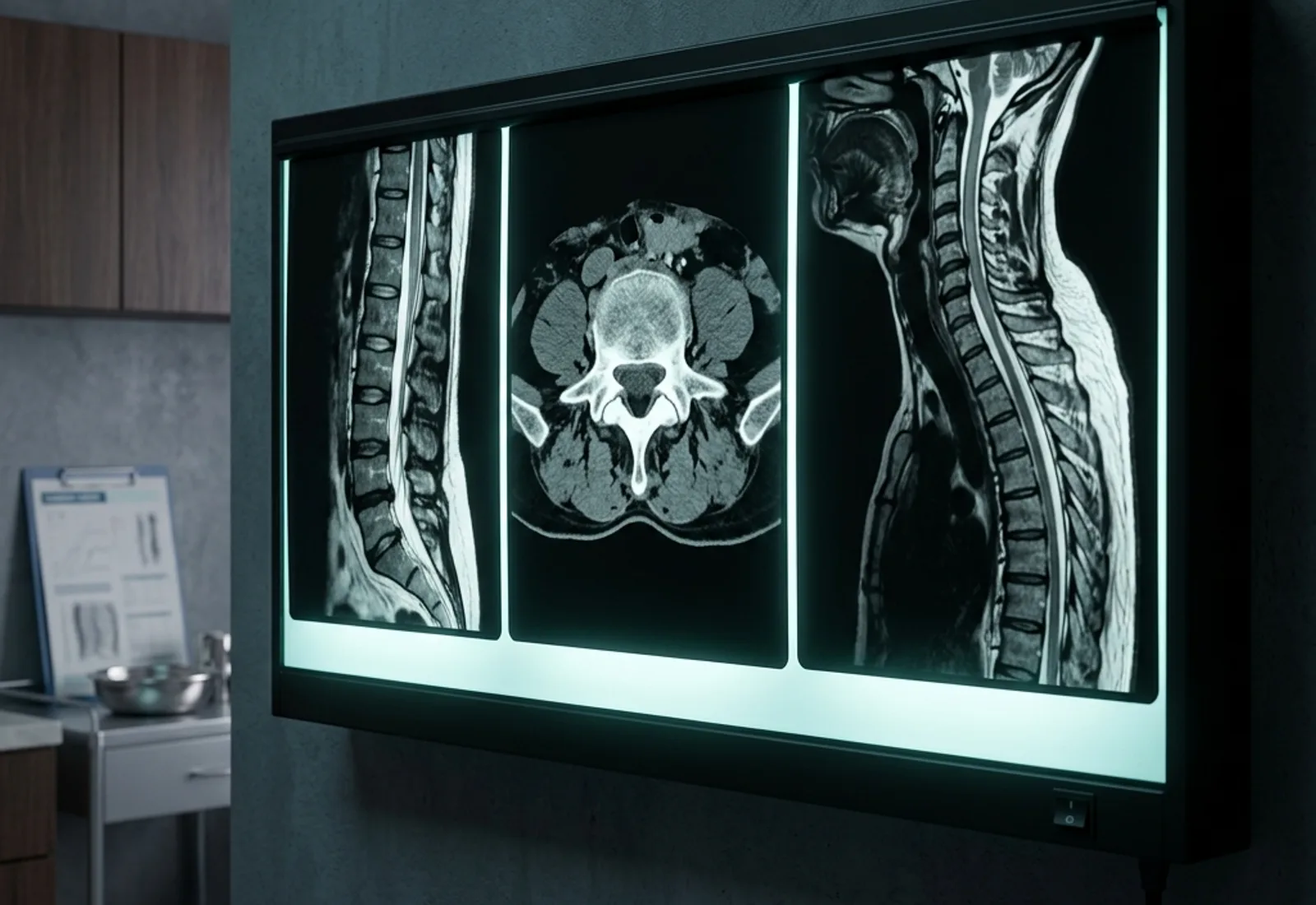
Modern neurosurgical medicolegal practice cannot rely on clinical examination alone, particularly in spinal and brain injury where high-resolution imaging and neurophysiological testing provide critical objective evidence.
Legal Spine routinely reviews MRI scans, including 3T studies where available, CT and CT myelography, and electrodiagnostic tests such as EMG and nerve conduction studies, rather than relying solely on radiology reports.
Guidelines emphasise that impairment and causation opinions must be grounded in both clinical and investigative findings, with imaging used to support and contextualise examination results rather than to dictate impairment ratings in isolation.
By correlating radiological and neurophysiological data with neurological signs and symptom history, the practice distinguishes age-appropriate degenerative changes from acute or acceleration injuries and can comment meaningfully on prognosis, likely progression and expected impact of proposed surgery.
- High-field MRI, including 3T sequences where available.
- CT and CT myelography for detailed canal assessment.
- Electrodiagnostic studies such as EMG and nerve conduction studies.
- Post-operative imaging following decompression, fusion or motion-preserving procedures.
Guideline-based impairment analysis
When statutory impairment or WPI is in issue, the practice applies the appropriate AMA-based methodology or scheme-specific guide with precision and transparency.
For TAC claims, this may involve AMA4 and, for eligible spinal injuries arising after 14 December 2016, the TAC spinal modification document. For WorkSafe matters, AMA-derived methods aligned with nationally agreed model guidelines are used, while Comcare assessments follow the Commonwealth permanent impairment guide.
In every case, the report states clearly which guide has been applied and shows the calculation pathway rather than presenting a bare percentage. The emphasis remains on showing how clinical findings are translated into impairment ratings, not on replicating entire manuals.
Report structure
The final report is the central product of the assessment and is structured so that each audience - claims manager, lawyer, conciliator, arbitrator, tribunal member or judge - can quickly locate the information required without sacrificing clinical detail.
Before a report is released, it undergoes an internal quality check for consistency between history, examination, imaging and conclusions, and for fidelity to applicable statutory frameworks and expert witness obligations.
- Background and instructions: referrer, scheme context, questions posed and relevant timetables.
- Materials reviewed: records, imaging, prior reports and other evidence considered.
- History: neutral summary of pre-injury status, accident or exposure, treatment and current complaints.
- Examination: detailed neurological and functional findings, including formal measurements where relevant.
- Investigations: synthesis of imaging and neurophysiological tests with the clinical picture.
- Diagnosis and differential diagnosis: clear statement of primary and alternative diagnoses where necessary.
- Impairment assessment: guide selection, categories used and calculation of WPI where applicable.
- Work capacity and functional opinions: sustainable duties, restrictions and prognosis.
- Treatment and management commentary: evidence-based comments on reasonableness and likely outcomes where within scope.
- Apportionment: allocation of impairment between compensable and non-compensable causes, with reasoning.
- Answers to specific questions: concise numbered responses cross-referenced to the relevant analysis.
Governance, privacy and data security
Medicolegal assessments involve sensitive health information, often combined with surveillance material, employment records and financial data. Legal Spine manages these materials with secure document transfer, controlled access to digital imaging and strict retention and deletion policies for photographs and video used in reports.
Photographs of scars, deformities or assistive devices are taken only where clinically or evidentially necessary, stored securely and deleted after a defined retention period once reports have been finalised and foreseeable disputes resolved.
Video-based assessments, such as telehealth interviews, are conducted via secure platforms, with any recording or screenshot capture disclosed and managed in accordance with privacy and medicolegal standards.
Continuous professional development and accreditation standards
High-quality medicolegal practice requires ongoing engagement with clinical advances and evolving scheme rules. Accreditation frameworks overseen by TAC, WorkSafe, Comcare and Wrongs Act authorities, and delivered through organisations such as AMA Victoria and the Personal Injury Education Foundation, require doctors performing impairment assessments to complete formal training and maintain current knowledge of guides and legislation.
Dr Aliashkevich's impairment assessment credentials reflect these standards and are supported by continuing professional development in neurosurgery, imaging and guideline-based impairment evaluation.
Regular review of scheme updates, court decisions and regulatory guidance ensures that Legal Spine's methods remain aligned with contemporary expectations.
For referrers, this continuous improvement translates into reports that do not merely meet minimum compliance, but reflect current thinking at the interface of neurosurgery, statutory compensation and forensic medicine.